On this page you will find information about the the history of Romahomes and the different models we have seen over the years.
A little Romahome History:
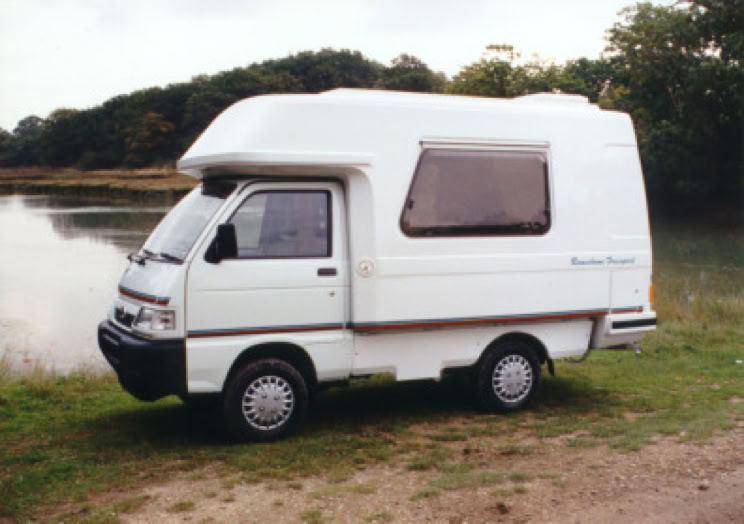
Made on the Isle Of Wight by Romahome Ltd (formerly Island Plastics) Romahomes are one of the most distinctive and therefore easily recognised motorhomes on the road.
The original idea of a dismountable 'caravan' on the back of a Japanese micro-truck belonged to Barry Stimson and whilst remaining faithful to Barry's original design criteria, the Romahome became better finished and more luxurious. In fact, when double-glazed windows became standard equipment and efficient space heating became an option (albeit at extra cost) it was possible to camp in a Romahome all year round.
"The ease of camping and the ease of parking make Romahome one of the best Micro-Motorhomes"
Later, as experience showed that few owners ever bothered to dismount
the 'caravan' from the truck, this made Island Plastics look elsewhere
for a suitable base vehicle. They first chose a Citroen Visa (later the C15)
as a suitable base vehicle but decided to go for a conventional coachbuilt
(not dismountable) body.
The choice of the Citroen proved a massive hit, promising car like
performance and economy -plus all the proven advantages of the
Romahome living unit - a functional interior with a fully equipped
(though tiny) kitchen and the luxury of having two full-length settees.
All this in a perfectly formed package measuring less than15 feet.
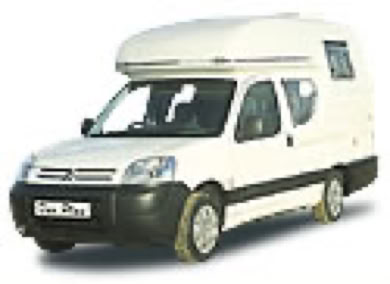
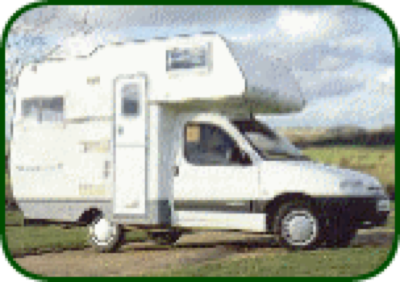
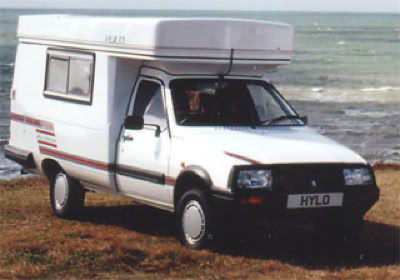
Later a Hylo variant was produced with a rising roof. The Hylo (pictured
top right) was designed to go into the average garage and under height
barriers. This was also built on the C15.
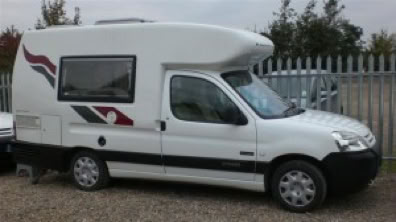
1998 saw the successful launch of the all new Romahome Duo and
Duo Plus (bottom right) which has the option of two rear forward facing
seats), both are built on the Citroen Berlingo.
The 'Outlook' and 'Dimension'
It seemed that some people preferred the larger window so the Outlook was brought out (left)outlook - this has the large picture windows as opposed to the four smaller ones on the Duo. Personally we prefer the four windows because you can see out without having to bend your head (particularly useful when you are tall!) plus with a picture window you are more on view to other campers and as the Romahome creates a lot of interest you can, at times, feel like you are on display.
"Romahomes bring a different 'Outlook' and
'Dimension' to camping!"
2003 saw the launch of the Dimension (right) this is built on the short wheelbase Citroën Relay with a 2.0 HDI common rail turbo diesel engine, power steering, remote central locking, engineimmobiliser, and electric windows as standard.It is totally different to the original Romahomes. Being larger but still only the same length. It has four forward facing seats, bathroom with toilet,
sink and shower.
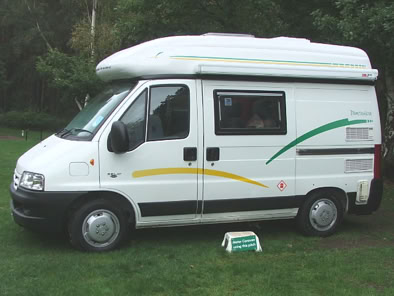
As opposed to the earlier vans the cab areas is utilised as part of the living area - driver and passenger seats turn round to face inwards and are also used to form part of the beds. You canchoose between one double or two singles beds. The Dimension has now been replaced by the R30 which is very similar but based on the new Relay with a 2.2 engine, the habitation unit has had some
tweets too, including flat seats which when used as beds don’t now need the overlay, sliding bathroom door, smaller tables and the cassette toilet is now accessed through the back door rather than the side, apart from that the interior is still the same tried and tested layout
New specification for 2005 Berlingo based Romahomes
Each has different options on upholstery and extras such as blown air heating, hot water,
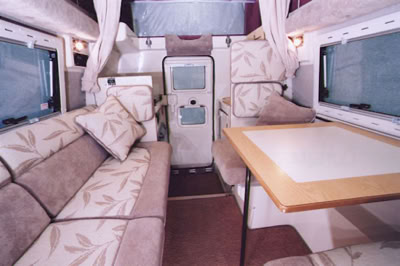
walnut dashboard, reversing sensors and there is also a new layout available with facing pullman' style seats on
the side with table between (picture right).
The seats have lap belts which makes the van much more suitaible for carrying rear passengers.
The beds have been made wider too, making a more comfortable nights sleep for those who
use the beds in the single bed mode.
"Small van BIG luxury"
Toilet option for the Berlingo based Romahomes:
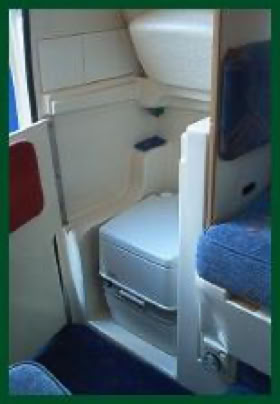
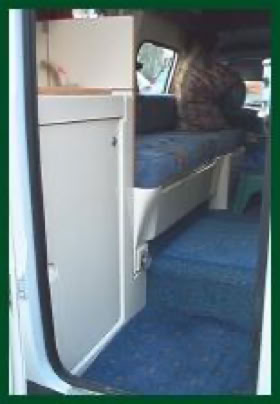
Later the option of an on-board toilet (porta-potti) was introduced - this is put in the place of the undersink
cupboard. The pictures (below) show a view taken from inside the van, it shows the toilet in situ. The other
picture is taken from outside the van, looking through the rear door. Here you can see that the toilet is completely
enclosed under the sink unit, it has a removable door for ease of access.
"The toilet may not the lap of luxury but just what you need in a traffic jam
or those remote areas!"
When required for use the sink lifts up and slots into an upright position
bove the toilet out of the way.
The porta potti goes into the space under the sink and can easily be removed
for emptying, it should be noted that it is not a cassette toilet.
For privacy there are curtains which divide the toilet area from the living
area and the rear blind and window curtain give privacy from outside.
Although it doesn't offer the luxury of a bathroom unit it proves
invaluable on long journeys, especially in France where public toilets are
few and far between. It is also a boon when stuck in the inevitable motorway
tail-backs which seem so common place these days! Another bonus is that at
night you do not to have to trek across the campsite to the toilet.
Other Romahomes:
"The range of Romahomes is quite diverse"
Out and about you will see Romahomes in many different forms. Quite often the same 'van' design
but many different base vehicles, Honda, Daihatsu and Suzuki to name but a few.
Also, but now out of production, you might see the Romahome Quartet (right). Also built on the
Citroen base vehicle this boasts a bathroom, over cab bed and all round seating at the back.
See our Quartet Page for more details about the Quartet.
Latest Romahomes
2008 saw the launch of the new R40 a six seater 4 berth Romahome see R40 page for details
From 2008 ? - All Romahome models were renamed with numbers - R10, R25, R30 (formerly Dimension) R40
© Small Motorhome.co.uk | Contact Us | Privacy Policy | Disclaimer