Forum

Twitter @smallmotorhome

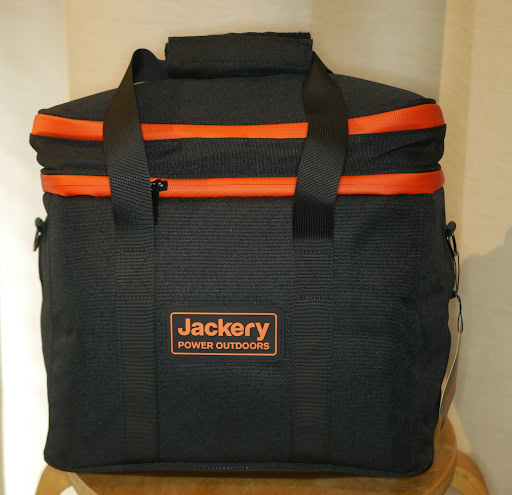
This is a neat, elegant package, primarily black or dark grey but with a striking orange styling.

The pictures show the main battery station's carry bag (this may be a separate add-on extra) and the generator which fits neatly inside. In the bag as well as the main section it also has a separate zip section containing the chargers and instruction manual. Internally it is foil lined so may well double as a cool bag.

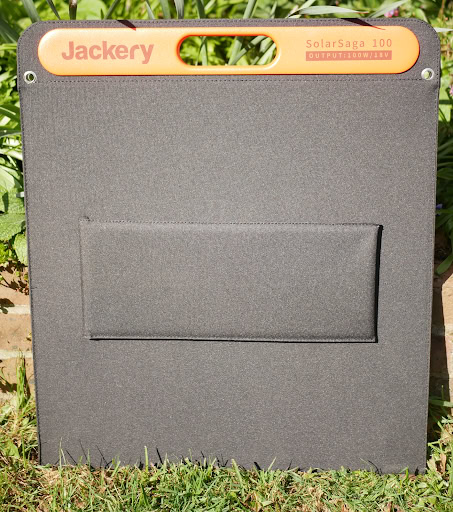
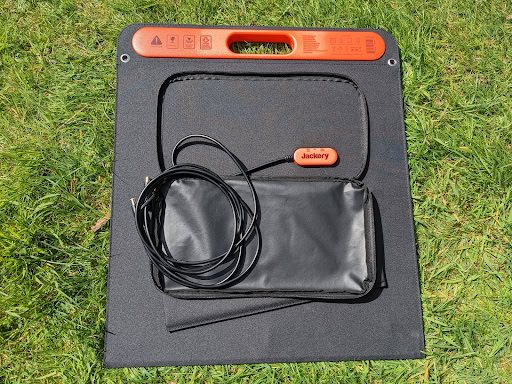
That natty styling continues to the solar panel (although taking a photograph in the bright sunshine may not make it appear so!)

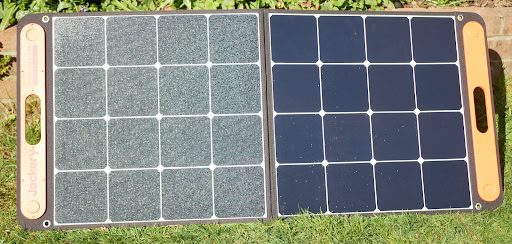
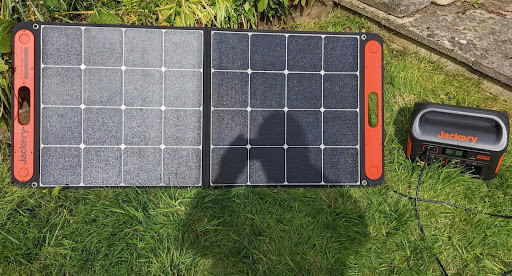
In fact the effect of that sunlight and it making photography difficult is clearly illustrated once I try to take a picture of the opened panel, but at least now the matching orange trimming is a little more apparent.

Both sides of that panel are the same – honest!

Jackery 500 Solar Generator and Solar Panel

Review by forum member brianthesnail

The Jackery Solar Generator 500 is a package consisting of Jackery’s Explorer 500 lightweight  portable power source, offering 12v, USB and 230v UK mains power (up to a maximum of 500W) combined with Jackery's SolarSaga 100W portable solar panel (which also offers an additional 2.4A USB A port and a 3A USB C port).


LOOKS

‍THE EXPLORER 500 POWER UNIT

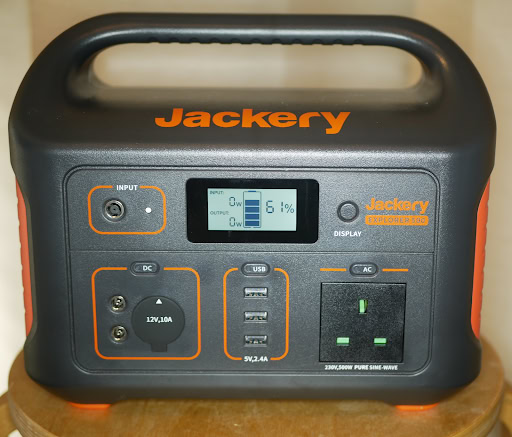
‍The main Explorer 500 has three different output options, USB (5vDC), 12v DC and 230v AC (mains).

USB

There are three separate USB inputs, each rated at 2.4A which is standard high power charging for most USB devices, including tablets and iPads. All the sockets are standard USB A so no USB C for charging higher voltage laptops and no Qualcomm fast charge but 3 standard sockets should be more than adequate for normal needs. The manual suggests there is a 30A max so in the unlikely event of all three sockets being used to the max one or more would be slightly reduced in its output.


Additional USB sockets, including a USB C one are included on the solar panel. I’ll cover these later in the review.

12V

12v is via a standard 10A “cigarette lighter” socket so compatible with most 12v camping equipment and also having the ability to add an additional USB adapter should 3 USB A sockets not be enough or if you need a Qualcomm fast charging USB port. The socket is covered by a simple weatherproof/dirtproof cap which also makes it looks much neater. In addition there are two barrel type connectors – these are listed as 6,5x1.4mm but that 1.4mm is the diameter of the internal pin, the connectors themselves are often listed online as 6.5mm*4.4mm. Not the commonest type of barrel connector but you can also get adapters which will convert the connector to a more common 5.5mm 2.1mm socket (for example https://www.poweradaptorsuk.co.uk/21mm-x-55mm-to-65mm-x-44mm-dc-power-plug-adaptor-113-p.asp).


I suspect the main use for the 12v output will be the cigarette lighter socket which would be ideal for driving a 12v coolbox or fridge.


230V Mains

A built-in inverter provides 230v AC mains electricity. This will provide 500W continuous power but will handle short peaks of up to 1kW. I decided to put this to the test, my Vango Sizzle induction hob is actually rated at 800W but I suspected setting it at 3 out of 5 LED power would be a good test. The Jackery display showed a pretty consistent 450W for the 5 mins or so it took for the small pan of water to boil. Impressive! OK so the battery percent level dropped steadily and lost about 9% during the experiment but it proves that the inverter is quite happy to provide mains at close to 500W.

Now, of course, that 230v is intended for lower power items such as laptops or perhaps a small mains fridge but it is reassuring that, at a pinch, it could run a low power induction hob to provide an emergency cuppa.

The inverter also claims to be pure sine-wave, this means it puts out nice clean 230v just like the mains at home. A good test for this was to make a transmission on my amateur radio kit, if the Jackery was not producing a nice clean power supply then my radio transmission would probably sound broken or distorted. So I hooked up it’s power supply and had a quick chat with Steve in Yorkshire (the other end of the country to me) who complimented me on my signal – well done Jackery! Additionally I could hear no extra noise when listening on the radio so that justifies the claim that the inverter is pure sine-wave. Good news, as one use I might have for it is to run a ham radio station whilst sat outside my campervan.


General

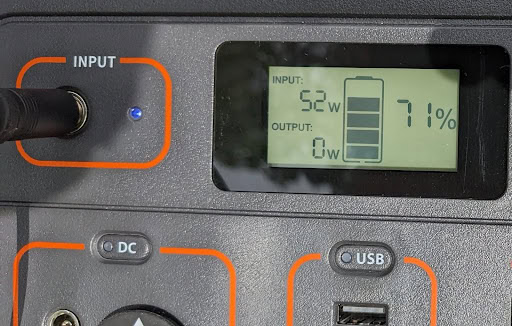
All three power sources, USB, 12v, and 230v can be switched on and off individually with little switches directly above the sockets. These switches have small green LEDs to show that that particularly power source is active. Additionally the LCD display shows current battery level (both as a icon and a percentage) and the input and output power . The input display is particularly handy when the device is connected to a solar panel as it monitors the performance of the panel, and the output display is useful to have some idea of just how much you are taking from the unit and give some indication of how long the battery might last given the current usage.

All sources are claimed to have protection against under & over voltage, short-circuit etc. This is important to protect equipment attached to the Jackery and also to protect against fires. I wasn’t brave enough to deliberately short one of the device’s inputs, I’ll believe the manufacturer on that one!

Accessories

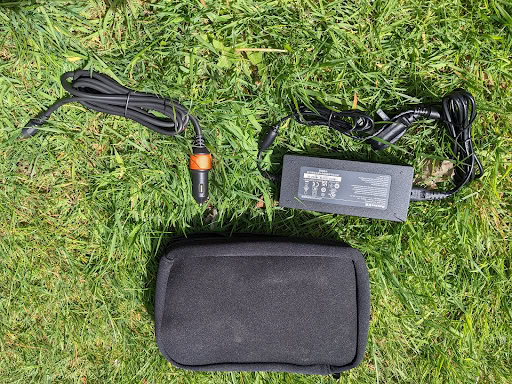
Also included with the Explorer 500 were a car charging cable and a 90W mains charger. The mains charger records 86W when plugged in and charges at approximately 15% per hour which means it’s about a six and a half hour charge to charge the battery up completely from empty. I didn’t get the opportunity to try the car charging cable but being able to charge whilst driving is obviously something very useful for this sort of device.

Oh, and I forgot to mention the small LED torch light on the side of the Explorer 500. It is pretty bright and might function as a small light in an awning or something. Obviously the unit itself is a bit bulky to carry around as a torch!


SOLARSAGA 100 SOLAR PANEL

Using the SolarSaga 100 as a charger is simplicity itself – the panel comes with an ample length 3m lead which simply plugs into the Explorer 500’s input socket.

The case has small fabric covered ‘legs’ which allow the panel to propped at a nice angle to catch the sun and even in the low, but bright sun of April, I was pleasantly surprised to see the unit peaking charging at 60W and getting 50W in today’s hazy sunshine. There are also small eyelets on each corner so the unit could be tied on to a support, car bonnet etc.


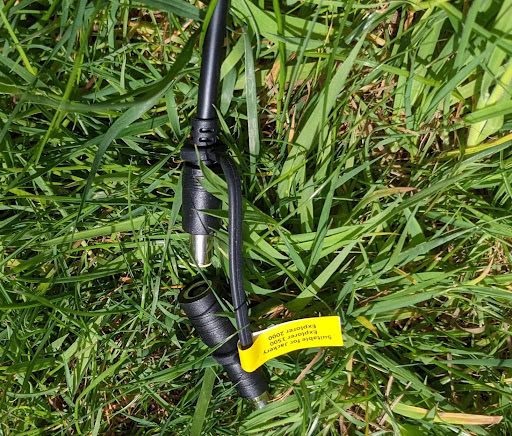
‍Interestingly the solar panel’s power lead also has an adaptor for a slightly different charging plug which means it can, apparently be used with the Explorer 1500 or Explorer 2000 units – a nice touch, avoiding having to buy a new adaptor if you ever upgrade the main unit. (see pic right).

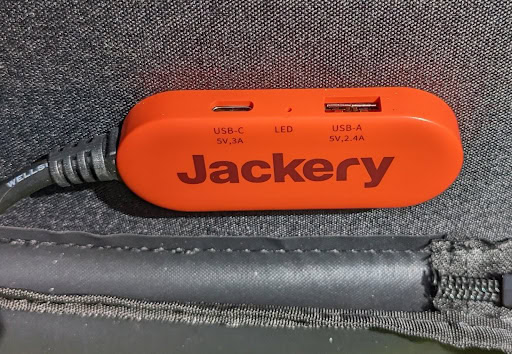
‍Note the little orange Jackery box in the photo on the left, that contains a USB-C, 3A socket and another USB-A 2.4A socket along with a little LED which shows the panel is active. Handy if you just want to use the panel stand-alone to charge your phone or tablet.

The solar panel doesn’t come in a travel bag but seems well protected and has a neat magnetic catch to stop it opening inadvertently.

So that’s it.


What did I like:

  • Neat and elegant styling
  • Attention to detail (the magnetic catch and extra adaptor on the solar panel, for example)
  • Simplicity of use (it really is plug and play)
  • Lightweight and seemingly robust


What might be improved:

  • A USB Qualcomm fast-charger or even USB-C for the Explorer 500
  • A more standard 12v barrel connector (although this will hardly affect most folks)
  • Perhaps another couple of USB ports would make the solar panel even more useful when stand alone.


Would I recommend it?

For tent campers, campervanners without a leisure battery installed, or car daytrippers who might need power – absolutely. It looks natty enough to sit alongside even the most trendy campervan, and the solar panel seems pretty efficient. It is light enough to be carried around fairly easily and the 500W 230V invertor is fine for most non-heating applications and perfect to keep the laptop charged. The 12v supply would be ideal for 12v coolboxes or fridges and, of course, we all need USB sockets!

I particularly liked the long 3m lead on the solar panel, this means the panel can be adjusted for maximum sun without moving the battery unit, or that the battery unit could be providing its power inside the tent/awning/campervan whilst the solar panel is outside topping up the unit’s charge.

Even though I have a 12v leisure battery and solar panel in my campervan I could see that the unit might be very useful as a second power source in an awning, or to allow me to use my amateur radio equipment sitting outside in the sun.

One concern I might have is that is really is quite an elegant and desirable setup and I would want to make sure that it was well secured. Fortunately the large handles on both the Explorer 500 and SolarSaga 100 would make it easy to slip a chain through and safely tether the unit to the car or wherever.


If you like the sound of the Jackery 500 Solar Generator you can buy one here:

https://uk.jackery.com/products/jackery-explorer-500-solarsaga-100w-solar-generator?aff=26


© Small Motorhome.co.uk | Contact Us | Privacy Policy | Disclaimer